

Short answer: A T-shirt tech pack is the instruction file a factory needs to sample and quote your tee. It should cover front and back flats, fabric (composition, weight in gsm, knit), the neck rib and neck finish, stitch types for hems and seams, a measurement chart with points of measure, grading and tolerances, a bill of materials, print placement, colorways, and labels and packaging. Get these right and the first sample is far more likely to match what you had in mind.
Last updated: November 2, 2026
The T-shirt looks like the simplest garment you can make. That is exactly why so many first tee samples come back wrong: the brand assumes the factory will “just know” the neck width, the rib, the hem stitch or how far the print sits from the collar. A factory only makes what the tech pack tells it. Everything else is a guess.
This guide is specific to tees. If you want the general version for any garment, read our page-by-page guide to what a tech pack is. Here we go through what a T-shirt tech pack needs, which details are unique to a tee, the points of measure to use, and a worked example based on our own tee template.
A T-shirt tech pack is a technical document for one tee style. It tells the pattern maker, the sample room and the production line what to make and how to check it. It is not a mood board and not a pretty drawing. It is a set of flats, specs, measurements and component lists that a factory can quote from and build to.
The rule we use: one garment style equals one tech pack. A crew neck and a V neck are two styles. A regular fit and an oversized fit are two styles. The same tee in black, white and navy is one style with three colorways.
Here is the content of a complete T-shirt tech pack, page by page, and why each page matters to the factory.
| Page | What goes on it | Why the factory needs it |
|---|---|---|
| Cover | Style name and number, season, brand, fit, size range, base size, date and version, colorway thumbnails | Identifies the style and the version they are quoting or sampling |
| Flats | Front and back technical drawings to scale, with seam lines and stitch lines shown | The pattern maker reads proportions and seam placement from here |
| Fabric | Composition, knit type, weight in gsm, finish, color references, rib fabric for the neck | Drives price, hand feel, shrinkage and fit |
| Trims and accessories | Neck tape, labels, hang tag, thread, any heat transfer | Every component has to be sourced and costed |
| Stitching and construction | Stitch type for shoulder, side seams, sleeve and body hems, neck rib attachment and back neck finish | Two tees with the same fabric can look and wear very differently because of construction |
| Details | Close ups of the neckline, hem width, label position, any special finish | Removes guessing on the small things that make a tee look premium |
| Measurement chart | Points of measure, how to measure, base size, grading for all sizes, tolerances | This is what makes the fit repeatable in every size |
| Artwork and placement | Print or embroidery file, size, technique, position measured from a fixed point | Prints end up in the wrong place when placement is vague |
| BOM | Every material and trim with supplier, color, quantity and placement | Used to source and cost the style |
| Labels and packaging | Main label, care and content label, size label, folding, polybag, carton marks | Needed for compliance and for goods to arrive ready to sell |
Some brands also add a fit comment page and a revision log once sampling starts. You do not need those for the first send, but you will need them by the second sample. If you want a line-by-line check before you send, our Factory-Ready Tech Pack Checklist covers each of these pages.
Most of what makes a tee look cheap or expensive sits in a handful of details. These are the ones to spell out in your tech pack instead of leaving to the factory.
State the full composition (for example 100% cotton, or a cotton and elastane blend), the knit (single jersey is the most common for tees), the weight in grams per square meter and any finish such as a garment wash, enzyme wash or pre-shrinking. Ask the factory or fabric mill for their shrinkage figures and state what is acceptable to you. If you are unsure which fabric to choose, our fabric guide explains the main types.
The neckline is the first thing a customer sees and the first thing that stretches out. Specify the rib type (for example 1×1 rib), its composition, the finished rib width, how it is attached, and how the back neck is finished. A common choice is a back neck tape from shoulder to shoulder, which covers the seam and helps the neck keep its shape. Also state the neck width and front and back neck drop as measurements, not only as a drawing.
Write the stitch type for every seam. On a typical tee that means the shoulder seam (often overlocked with a shoulder tape for stability), the side seams (overlocked, unless the body is tubular), the sleeve and body hems (often a coverstitch with a stated width) and the neck rib attachment. Name the hem width in millimeters or centimeters. A hem that is a few millimeters wider or narrower changes the look of the garment.
Describe the fit in words (regular, slim, boxy, oversized) and support it with measurements. Words alone mean different things to different factories. The half chest, body length and shoulder width together define the silhouette, so mark these as critical.
For any artwork, give the technique (screen print, digital print, heat transfer, embroidery), the artwork size, the color references and the exact position. For labels, say whether you want a sewn neck label, a printed neck label or a tear-away label, and where the care label sits.
Points of measure (POMs) are the exact places where the garment is measured. Each one needs a short definition so the factory measures the same way you do. These are the usual POMs for a basic short sleeve tee, measured with the garment laid flat:
| Point of measure | How to measure | Critical? |
|---|---|---|
| Body length | From the high point shoulder (HPS) straight down to the hem | Yes |
| 1/2 chest | Straight across, a set distance below the armhole, edge to edge | Yes |
| 1/2 bottom width (sweep) | Straight across the hem, edge to edge | Yes |
| Shoulder width | From shoulder point to shoulder point | Yes |
| Sleeve length | From the shoulder point to the sleeve hem edge | Yes |
| 1/2 sleeve opening | Straight across the sleeve hem | No |
| 1/2 biceps | A set distance below the armhole, perpendicular to the sleeve fold | No |
| Armhole | Along the armhole seam, measured straight or curved (state which) | No |
| Neck width | Seam to seam at the neck, across the back | Yes |
| Front neck drop | From the HPS line down to the neck seam at center front | Yes |
| Back neck drop | From the HPS line down to the neck seam at center back | No |
| Rib width | Finished width of the neck rib | No |
| Hem width | Finished width of the sleeve and body hem | No |
Pick which POMs are critical for your style. For a fitted tee the chest and body length may be strict. For a boxy tee, the shoulder and sleeve may matter more. A raglan sleeve changes the shoulder and sleeve definitions, so write how you measure them.
The chart then needs the measurement for every size, a base size (often M) and a tolerance for each POM. We go through grading, tolerances and how to build the chart in our guide to tech pack measurements.
This is an illustrative extract, not a recommended fit. The base size is M. The grade is the fixed change between sizes.
| Point of measure | Grade | S | M (base) | L | XL | Tolerance +/- |
|---|---|---|---|---|---|---|
| Body length from HPS | 2 | 69 | 71 | 73 | 75 | 1 |
| 1/2 chest | 3 | 51 | 54 | 57 | 60 | 1 |
| 1/2 bottom width | 3 | 50 | 53 | 56 | 59 | 1 |
| Sleeve length | 1 | 19.5 | 20.5 | 21.5 | 22.5 | 0.5 |
| Neck width | 0.5 | 17.5 | 18 | 18.5 | 19 | 0.5 |
Illustrative values in centimeters, garment measured flat. Use your own block and fit sample to set real values.
Measure placement from a fixed point on the garment, never from “the middle of the chest”. The most common reference points on a tee are the high point shoulder and the center front. For a chest print you would typically state the distance down from the HPS to the top of the artwork, and that the artwork is centered on center front. Add the artwork size (width and height), the technique and the ink or thread colors.
Show it on the flat with dimension lines, and say whether the size is the same across all sizes or graded. If the print is large, think about how it sits on the smallest and largest sizes.
A tee has fewer components than a jacket, but the list is longer than most people expect. A typical T-shirt BOM includes:
For each line, add supplier, reference, color, placement and quantity per garment. Our article on the bill of materials for clothing includes a full T-shirt BOM example and explains how to build one.
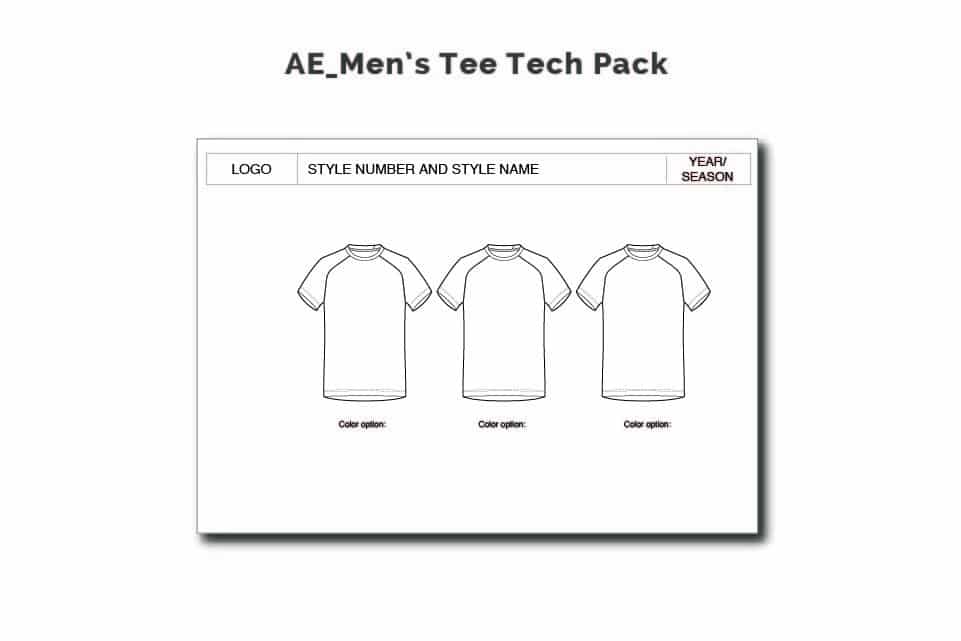
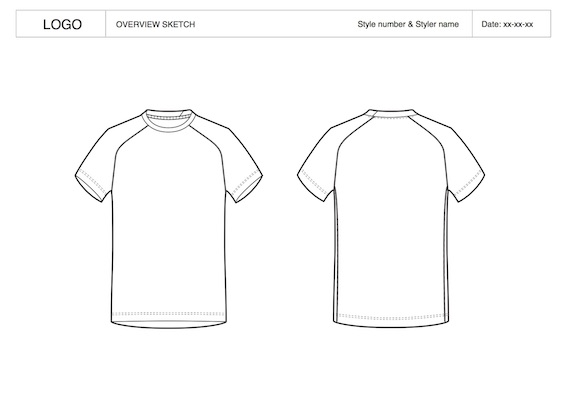
Here is how our Men’s Tee Tech Pack Template is laid out. It is six pages in Adobe Illustrator, drawn as a raglan tee, and you edit the flats into your own style.
| Template page | What you fill in |
|---|---|
| 1. Cover | Logo, style number and name, year and season, and up to three color options shown as flats |
| 2. Overview sketch | Front and back flats with style number, name and date in the header |
| 3. Fabric instruction | Callouts for the main fabric and rib, with composition, weight and color references |
| 4. Trims and accessories instruction | Callouts for neck tape, labels and other trims, placed on the flat |
| 5. Stitch and lamination instruction | Callouts for every seam and hem with stitch type and width |
| 6. Detail instruction | Close ups of the neckline and other details that need extra explanation |
The template covers the drawing and instruction pages. Most brands keep the measurement chart and the BOM in Excel next to it, because those are easier to update during sampling. Our Men’s Fashion Tech Pack Bundle adds a T-shirt measurement list, a T-shirt BOM template and a tolerance document if you want those as well.
To show the level of detail we mean, this is how the stitch page could read for a simple crew neck tee. It is an example of format, not a construction recommendation for your product.
If you can draw in Illustrator and you know garment construction, you can build one from scratch. Most founders save time by starting from a template, because the page structure, headers and callout layout are already done and you only change the flats and the information. If you are not sure what route fits your budget, we compare templates, software and freelancers in how much a tech pack costs.
Whichever route you pick, send the tech pack together with your questions, and ask the factory to confirm in writing what they will use for anything you have left open.
Men’s Tee Tech Pack Template, $39
A ready-made T-shirt tech pack in Adobe Illustrator: six pages covering cover, overview sketch, fabric, trims and accessories, stitching and details. Edit the flats into your own tee and fill in your information. Digital download.
Making a women’s tee? Use the Women’s Tee Tech Pack Template, also $39.
A T-shirt tech pack is the set of instructions a factory uses to sample, quote and produce your tee. It shows the flats, fabric, neck rib, stitching, measurements with tolerances, trims, print placement, labels and packaging for one style.
A cover page, front and back flats, fabric and rib details, a stitch and construction page, a measurement chart with points of measure and tolerances, a bill of materials, print or embroidery placement, colorways, and label and packaging instructions.
There is no fixed number. A simple tee often fits in six to ten pages. Our Men’s Tee Tech Pack Template has six drawing pages in Illustrator, and the measurement list and BOM are usually kept in Excel next to it.
No. One style gets one tech pack, and colorways are listed inside it. A new fit, a new neckline or a different fabric is a new style and needs its own tech pack.
Body length from the high point shoulder, half chest, sweep or bottom width, shoulder width, sleeve length, sleeve opening, neck width and front and back neck drop. Mark the ones that matter most for fit as critical.
Yes. Many brands draw flats in Illustrator, but you can also use other vector tools or software built for tech packs. What matters is that the flats are clear, to scale and match the measurements.
Skip the blank page for your t-shirt
The Men’s Tee Tech Pack Template gives you editable flats, a BOM, a measurement list and construction pages in Illustrator, ready to fill in with your own specs.
Get the Men’s Tee Tech Pack Template – $39
Before you send it, check every page with the Factory-Ready Tech Pack Checklist ($29)


Editable tech pack, vector flats, croquis, BOM and measurement lists.
From $97
Browse templates Men's & Women's bundle $199 ›
